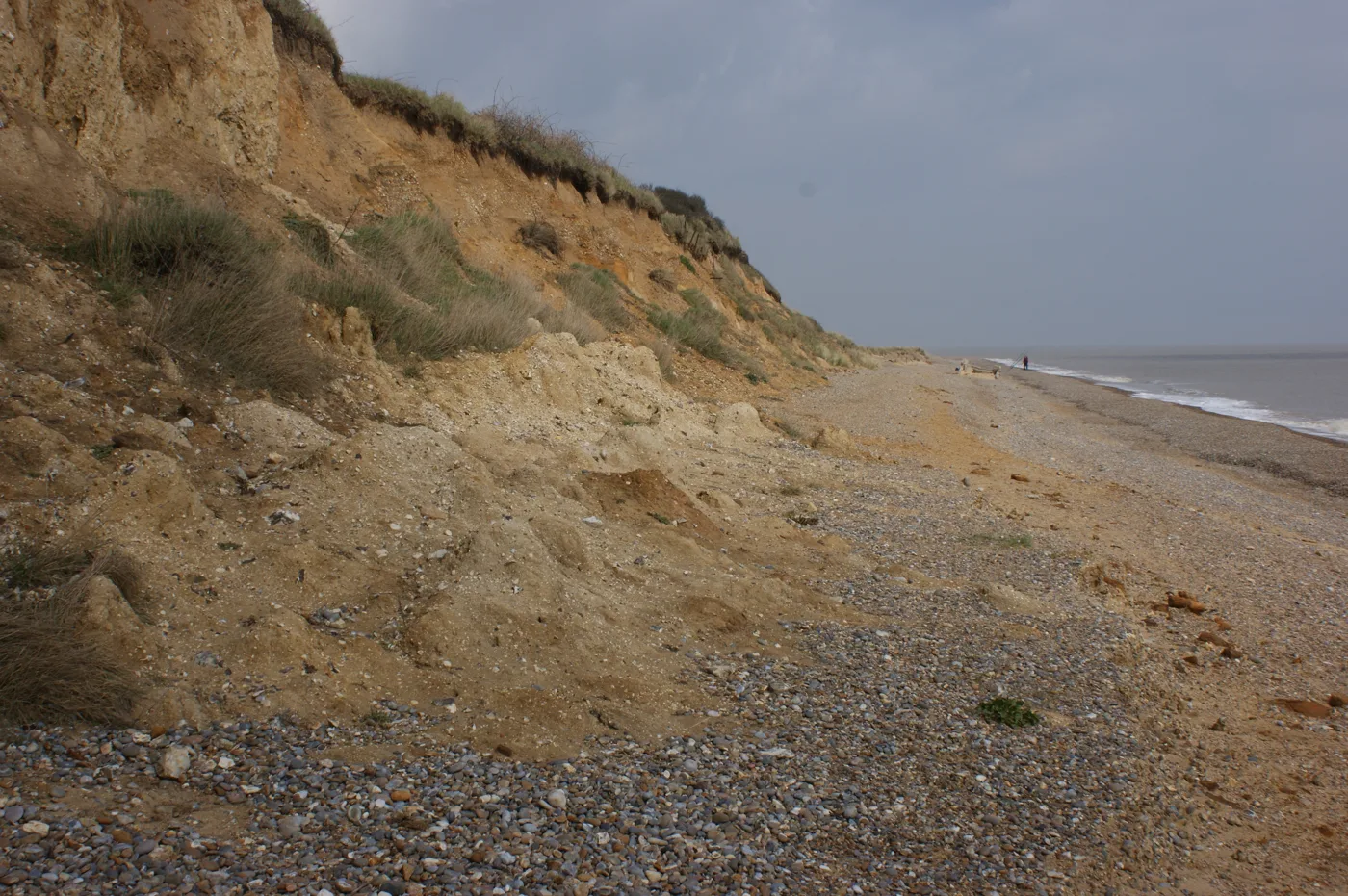

East Suffolk Council has given itself permission to keep 2,500 tons of Thorpeness beach rock in a field north of Beacon Hill Lane for up to three years.
The rocks coming off the beach at North End Avenue in Thorpeness can be kept in a field north of Beacon Hill Lane for up to three years. East Suffolk Council granted itself planning permission for the storage site on Monday 16 November.
The application, DC/26/3105/RG3, was the council’s own. It covers about 2,500 tons of rock. Thorpeness is on the coast about two miles north of Aldeburgh, and about 17 miles north-east of Woodbridge.
Overview
- What was approved: a temporary rock storage area in part of a field north of Beacon Hill Lane, about 450 metres north of the beach.
- How long: up to three years from 16 November 2026. After that the rock must go and the field returns to farmland.
- How much rock: about 2,500 tons, from the 35-metre revetment put in as an emergency measure in 2021.
- Who decided: council planning officers, under delegated powers. It did not go to the planning committee.
- Objections: 21, plus one comment that neither objected nor supported.
Why the rock is going into a field
The council’s own position statement on the application sets out its reasoning. A report it commissioned after the erosion in early 2026 found that leaving the rock in place risked further erosion to the south. That could put North End Avenue itself at risk.
Taking the rock off the beach should release the sediment held to the north. The report predicted that would rebuild the beach to the south.
The council says it wants the rock kept close by. That leaves the chance of a “private community lead scheme” reusing it in future.
The officer report adds that the revetment “never received formal planning permission”. It also says the rock was installed “without fully understanding the relevant coastal change processes it would lead to”.
What the permission allows
The decision notice carries six conditions. The main ones:
- Three years at most. The rock must then be removed and the land put back as it was.
- A set way of clearing the route. Scrub north of North End Avenue is cut from south to north, the cuttings are taken away, and track matting goes down for the dump trucks.
- Replanting. Within a month of the works finishing, the council must submit a plan to replant the cleared strip.
- A plan before the rock moves again. Before any rock leaves the field, a method statement on the haul route and transport has to be agreed.
The rock will be laid out no more than one rock high, on the ground as it is. The council’s methodology gives a stockpile area of 20 metres by 100 metres. The officer report says it is set back behind a hedgerow from a public footpath to the south.
How the rock gets there
The methodology describes the job:
| Machines | a 50-tonne excavator with a rock grab, a 35-tonne excavator, two 30-tonne dump trucks |
| Each rock | about 2,600kg |
| Hours | 8am to 6pm, adjusted to the tides |
| Length of job | 7 to 10 days |
The haul route runs over private land, not public roads. Part of it uses an existing track through the Leiston-Aldeburgh Site of Special Scientific Interest. A strip of scrub about 4.5 metres wide and 30 metres long is cleared at the top of North End Avenue. Most of it is Japanese rose, a non-native plant the officer report says should be replaced with native scrub.
The route passes a public byway, Thorpe BOAT 020. Suffolk County Council’s rights of way team did not object, on condition that a construction plan for the byway is followed. That plan includes a survey of the route before the work and repairs afterwards.
What the parish council wanted
Aldringham-cum-Thorpe Parish Council said it “understands the rationale” for moving the rock. In its comments it asked for two things:
- a construction management plan before any work, setting hours, vehicle sizes, daily lorry numbers and how high the rock could be stacked
- a condition that the rock is kept only for coastal protection at Thorpeness
It got a version of the first: the approved plans include a methodology and a construction plan for the byway. It did not get the second. The officer report says a planning decision “cannot restrict who the rock can be provided to in the future”. That is a decision for the council’s cabinet members.
If no scheme comes forward in three years, the report says the rock “may be moved away from the area” for use elsewhere in the district or for other uses. The council would decide that at the time. The rock could then leave by a haul route west to the B1353 across the landowner’s land, without going through the village.
Where things stand
The council’s November factsheet had planned the removal for 11 to 15 November, as we reported when the work started. The storage permission is dated the day after.
We could not confirm today whether all the rock is now off the beach. The council’s website, where it posts its Thorpeness updates, could not be reached on 22 November.
The decision follows the council’s rejection in October of a community plan to reuse the rocks further along the beach.
What it means for you
- If you walk the footpath south of the storage field, expect to see the rock behind the hedge for up to three years. The officer report says the hedgerow “will help to screen” it from wider views.
- If you live at the north end of North End Avenue, the cleared strip at the end of the road should be replanted in the first planting season after the work ends.
- If you are part of a group hoping to reuse the rock, any scheme needs its own permissions and licences, including a haul route and construction plan. The officer report says the council has not yet had a formal planning application for one.
- If you have questions, the council’s coastal management team takes them at coastalmanagement@eastsuffolk.gov.uk.
Have your say