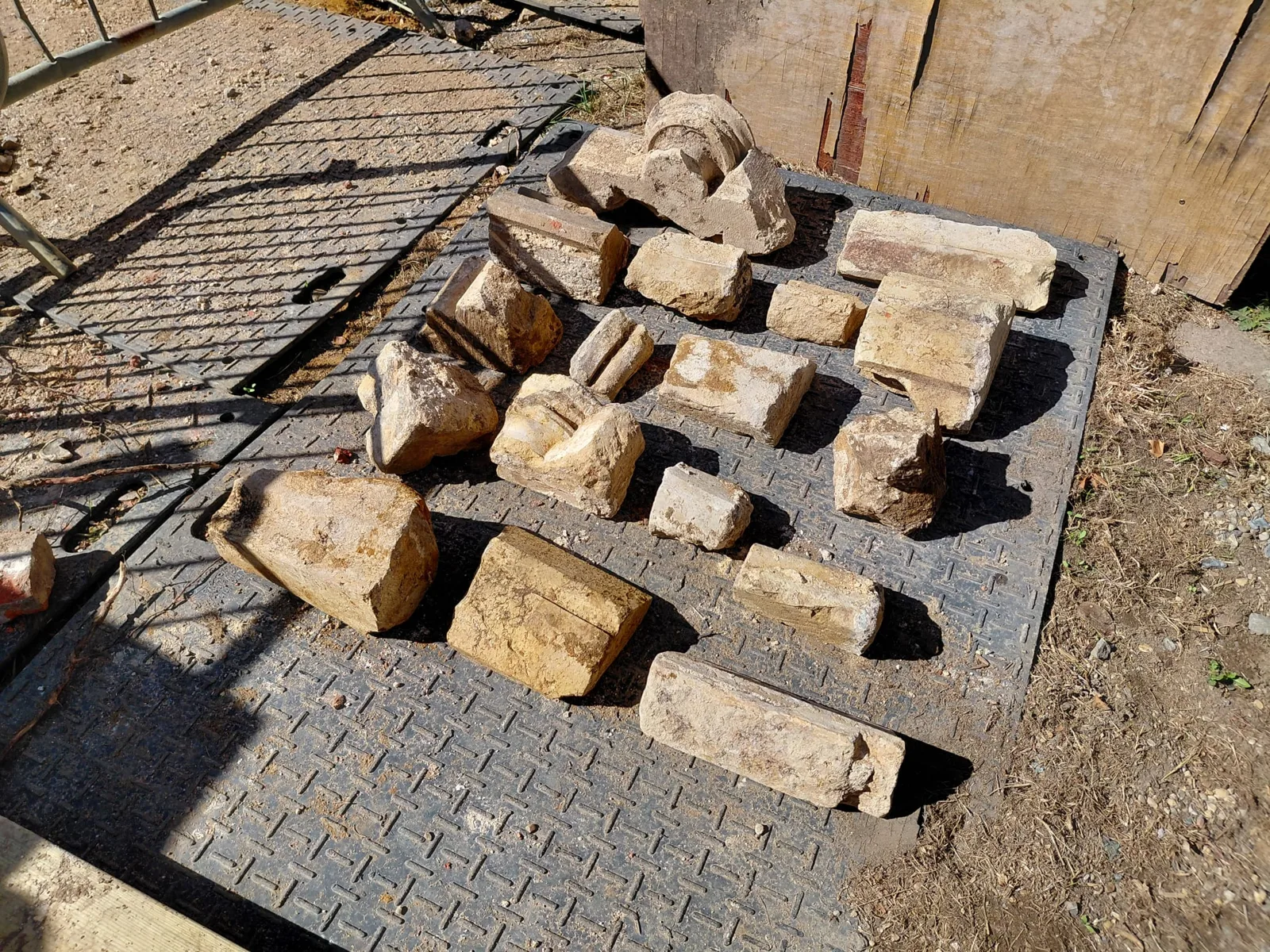

Painted carved stone, possibly mid-13th century, has come out of St Mary's churchyard wall in Woodbridge. Where it may be from, and when rebuilding starts.
Carved stone that may be nearly 800 years old has been found inside the churchyard wall of St Mary’s Church in Woodbridge. It came out while a failing section of the Grade II listed wall was being taken down for rebuilding.
A buildings archaeologist’s first look suggests the stonework is early English and may date from the mid-13th century. That is older than the 15th-century church it surrounds. East Suffolk Council announced the find on 28 September.
What was found
Some carved and plain fragments were already visible in the face of the wall. More turned up as the unstable section was dismantled by hand. The salvaged pieces have been set aside and stored securely.
Matt Champion, a buildings archaeologist with MJC Associates, made the preliminary assessment. According to the council, he found:
- high-quality workmanship
- traces of red and black painted pigment
- masons’ setting-out marks, the lines a mason scored to guide the cut
- classic architectural pieces of the kind that carry load or add decoration to a building
His view is that the stone is early English in origin, possibly mid-13th century. Further research is planned, with expert help, to establish what the pieces are and how significant they are.
Where the stone could have come from
The council says the origin is not yet known. It gives two likely sources.
The earlier church. The present St Mary’s is a 15th-century building. It replaced an earlier church that was demolished to make way for it. The listing description records the current church as Grade I, 15th century, built of knapped flint with flushwork and stone dressings.
Woodbridge Priory. A house of Augustinian canons stood next to the churchyard, on the land now occupied by the Abbey School. The Victoria County History records that the priory was founded about 1193 by Ernald Rufus, dedicated to the Blessed Virgin, and suppressed in February 1536-7, which is 1537 by the modern calendar. Its site was then granted to Sir John Wingfield and his wife Dorothy.
Either way, the pieces appear to have been reused as walling stone, which is why some were already showing in the wall’s face.
Why the council is doing the work
St Mary’s churchyard is closed to new burials. When a churchyard closes, responsibility for maintaining it can pass to the local council. East Suffolk Council says it now looks after 29 closed churchyards across the district, St Mary’s among them.
An assessment found part of the listed wall unstable and in poor condition. The council is overseeing its reconstruction.
Cllr Mark Packard, the cabinet member for planning and coastal management, said: “This is a fascinating discovery which gives us a glimpse into Woodbridge’s medieval past.”
He added that making the wall safe remains the priority, and that the fragments “will now be carefully assessed so we can better understand their history and significance”.
What happens next
- The analysis comes first. Rebuilding the wall above churchyard level will not start until the salvaged stone has been examined further.
- Rebuilding is expected to start in mid-October, the council says.
- No finding yet on what the pieces were. The council has not said whether they will be displayed, returned to the wall or kept elsewhere.
We will update this story when the council publishes more on the finds.
What it means for you
The work is on a section of the churchyard wall, not the church. With rebuilding not expected to start until mid-October, the repair will run on through the autumn.
If the stone did come from the priory, it would be one of the few visible links left to a religious house that stood beside the churchyard for more than three centuries. For more on what is changing in the town, see our planning news and things to do in Woodbridge.
Have your say